How Long Do Baby Wombats Stay in the Pouch
Facts About Wombats
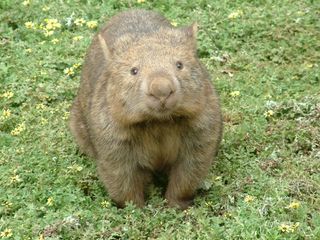
Wombats are small marsupials that look like a cross betwixt a bear, a pig and a gopher. They are congenital for earthworks, with curt legs, compact heads, short broad feet and strong claws. Like kangaroos, koalas and other marsupials, they have a pouch. But a wombat'south pouch is backwards. And their poop is cube-shaped.
Size
Wombats are virtually as big as a medium-size dog, typically xxx inches (76 centimeters) long. The common wombat weighs 55 to 88 lbs. (25 to xl kilograms), and the hairy-nosed wombat weighs 42 to 71 lbs. (19 to 32 kg), according to the San Diego Zoo.
Habitat
All wombat species live in Australia and Tasmania in mountains, forests and grasslands. Their homes are burrows, which consist of many tunnels and sleeping chambers. Some tunnels in a burrow can reach up to 650 feet (200 meters) in length, according to the San Diego Zoo. Some wombats have several separate burrows that they live in throughout the year, according to the University of Michigan's Animal Diversity Spider web (ADW).
Habits
Some wombats are social, while others are loners. For instance, the mutual wombat spends most of its time alone, while the hairy-nosed wombat tin can live with up to 12 other wombats in its burrow. A group of wombats is chosen a mob or colony, according toNational Geographic.
All wombats are nocturnal and spend their nights foraging for food or digging. During cold days, some wombats do come out of their burrows to sunbathe and warm up. They do not climb trees similar koalas, their nearest relative, just they are good swimmers, according to the Wombat Information Center.
Diet
Wombats are herbivores, which ways they just eat vegetation. Some common meals for a wombat include roots, grasses, scrub, herbs and bark. They get most of their water from the foods they eat and can live years without drinking water.
Wombats have special enzymes in their stomachs to digest tough roughage, but yet, it nonetheless takes around fourteen days for a wombat to assimilate a meal.
Cubic poop
Awombat's feces are shaped like cubes. Wombats use their poop to marker their territory. They will place a poop cube on fallen trees, fresh mushrooms and rocks. Cubed poop won't roll off, according to Tasmanian Wildlife Management. [National Geographic Video: Cubic Wombat Poo]
Offspring
Wombats typically mate during times when food is abundant. If at that place is a drought and food is non abundant, the wombat volition not mate. Male wombats volition fight for the right to mate with a female. The fibroid-haired wombat will chase a female person in circles until she slows down long enough that he tin catch her to mate, co-ordinate to the ADW. The female person volition make a cough noise as they are chased.
A female person wombat has a gestation menses of effectually 21 to 30 days. She gives nascency to just one immature at a time every ii years.
A baby wombat is called a joey. At nativity, a joey only weighs 2 grams, and is nigh the size of a jellybean, according to the Wombat Information Centre. The joey climbs into its mother's pouch right after birth to finish developing and stays there for around five months.
A wombat'south pouch is backward; it opens toward the bottom, instead of towards the chest. This prevents dirt and droppings from entering while burrowing. A joey clamps down on its mother's teat, which helps prevent it from falling out, according to the Wombat Data Center.
After five months, the joey volition climb in and out of its mothers pouch for another few months. Wombats become mature at ane.5 to 3 years and live five to 15 years in the wild and over 20 years in zoos.
Classification/taxonomy
Here is the taxonomy of wombats, according to the Integrated Taxonomic Information Arrangement (ITIS).
Kingdom: Animalia Subkingdom: Bilateria Infrakingdom: Deuterostomia Phylum: Chordata Subphylum: Vertebrata Infraphylum: Gnathostomata Superclass: Tetrapoda Class: Mammalia Subclass: Theria Infraclass: Metatheria Order: Diprotodontia Suborder: Vombatiformes Family: Vombatidae Genera & species:
- Lasiorhinus krefftii(Northern hairy-nosed wombat)
- Lasiorhinus latifrons(Southern hairy-nosed wombat)
- Vombatus ursinus (common wombat, coarse-haired wombat)
Conservation status
Co-ordinate to the International Union for Conservation of Nature (IUCN), but one type of wombat is endangered. The Northern hairy-nosed wombat has gained this distinction because it tin merely be constitute in a very modest location known as Epping Forest National Park. The quality of that small habitat is likewise declining due to invasive exotic grasses. There are only 115 Northern hairy-nosed wombats left.
Other facts
During the Pleistocene, herds of giant wombats the size of a rhinoceros roamed the plains of southern Australia.
Though wombats take short legs they can run up to 25 mph (forty kph).
The pare on a wombat'southward lesser is very thick and tin withstand bites. It often uses its rear to block the archway to its burrow.
Boosted resources
- Wombat Information Center
- San Diego Zoo: Wombat
- National Geographic: Mutual Wombat

Alina Bradford is a contributing author for Alive Science. Over the past 16 years, Alina has covered everything from Ebola to androids while writing health, scientific discipline and tech articles for major publications. She has multiple health, safe and lifesaving certifications from Oklahoma State University. Alina's goal in life is to try as many experiences as possible. To date, she has been a volunteer firewoman, a dispatcher, substitute instructor, artist, janitor, children's book author, pizza maker, issue coordinator and much more.
Source: https://www.livescience.com/52640-wombats.html
0 Response to "How Long Do Baby Wombats Stay in the Pouch"
Post a Comment