What Art and Style of Art Influenced Talbot in His Creation of the Open Door?
WILLIAM HENRY FOX TALBOT (1800-1877)
The Pencil of Nature (1836)
THE CALOTYPE
By 1835, William Henry Play tricks Talbot, an English gentleman, prominent landowner, accomplished mathematician, and apprentice experimenter in the photographic arts had produced the world's commencement negative, the first half of what would be the ground for the modern "positive"-"negative" procedure in photography. Merely Talbot was anything but an entrepreneur and it is clear that from the start, photography was, for Talbot, a mechanical form of sketching and cartoon, an art form that he equally a country squire would pursue in his leisure time. He was also, typical of his time, office of a large network of amateur scientists who were honored and appreciated in the days in which science could exist practiced outside of the cloisters of academia and his work in photography would have been function of experiments with calorie-free and thus fitted into a broader context. All of which explains why Talbot saw no demand, in the mid-1830s, to either proceed his hobby or to brand whatsoever public announcements on his work. But across the English Channel, a French inventor, named Louis Jacques Mandé Daguerre (1787-1851) appear the "invention" of the daguerrotype, a mode of photography, in Baronial of 1839. Talbot, who had invented his own mode of photographing, was galvanized into re-activity.
Incidentally, the term "photography," pregnant "writing with calorie-free," had not nevertheless been named. Equally has been previously noted in previous posts on this site, "photography" in England was adult within the realm of science, as opposed to the shift in France, under the guidance of Daguerre, to the commercial and artistic world. Sir John Herschel (1792-1871), close friend of Talbot, and renowned scientist, began as early every bit 1830 to make up one's mind the defining characteristics of a set of experiments with nitrate of argent and hyposulphite of soda, studies that were still on going. In their article,Proof Positive in Sir John Herschel'southward Concept of Photography(2002), Kelly Wilder and Martin Kemp noted that the precise naming of the process/es was tantamount to claiming the invention itself. They write that in 1727, Johann Heinrich Schulz had named the means by which silver salts darkened in sunlight as "scotophorus" and noted that an eighteenth century novel accurately described the photographic process. Despite the naming, the modernistic history of photography unremarkably begins, not with Thomas Wedgwood, but with Joseph Nicéphore Niépce, who invented héliographie in 1827. "Sun pictures" was followed past other names, all of which disturbed Herschel, the premier mind, who determined the proper naming of scientific thought. Scientists really approached him to properly "name" their piece of work. Herschel wanted names to be empirical and descriptive and office of a organization, rather than colorful and poetic and meaningless words, such as "daguerrotype." Such a name, reflecting the inventor, says naught most the process and is hence useless.
In March of 1839, Herschel delivered a newspaper "Notation on the Fine art of Photography of the Awarding of the Chemical Rays of Calorie-free to the Purposes of Pictorial Representation," months before the 1839 Arago declaration in Paris. Manifestly his relationship with Talbot had inspired him to consider photography as a serious candidate for mod naming in a precise manner. But unlike Talbot, every bit Wilder and Kemp pointed out, Herschel did not consider a photograph a form of drawing merely an imprinted fossil or a trace of the real, part of scientific ascertainment, non fine art, and hence, worthy of his attention. It seems that the scientist understood photography, the sake style as Niépce, every bit being linked to printmaking. For Herschel, photography was to be an help to scientific inquiry and though of photography as a tool for copying nature of empirical information. Photography was evidence, irrefutable proof of truth. Herschel showtime used the term "photography" in print in English in the wintertime of 1839 and, due to his considerable importance in the world of science, the name stuck. But cheers to Talbot, photography was first established equally an fine art course, as the "pencil of nature," through independent photographs, artfully equanimous images of selected views of Lacock Abbey.
Upon hearing of Daguerre's work, Talbot immediately wrote to François Arago, noting his prior claim to invention, simply he was, obviously, also tardily. It is of import to note that in that location were ii stages to the announcement of the "invention of photography:" beginning, at that place was a "disclosure" of the work of Daguerre in January of 1839 and so 2d, there was the actual public proclamation with corking fanfare made by Arago in August 1839. In gild to strengthen his example, Talbot attempted to publish papers on his photographic experiments with the Royal Lodge, and Some account of the art of photogenic drawing was published early on in 1839, just, for some reason, the Social club was uninterested in publishing any of his other papers on his photographic processes. In his first paper, Talbot wrote that "This remarkable miracle, of what ever value it may plow out in its application to the arts, will at least be accustomed as a new proof of the value of the inductive methods of modern science." Next, over again to make sure he was not overrun past the French excitement, Talbot returned to the task of improving his images, which he now dubbed "calotype," meaning "cute print," just the kind of unexacting term that Herschel would have disliked. His friends used the term "Talbotype," a dainty compliment, just hardly descriptive of the complicated process of capturing an image, printing the image and publishing the epitome.
Even so, in the 1840s Talbot had several problems he could not easily overcome. In contrast to Daguerre, who gave the knowledge of his process to the world, Talbot decided to protect his work, the "Calotype Photographic Process" with a patent in England in 1841 and in America in 1847. In a fast moving field where improvements were constant, the patent was a about useless protection. When he attempted to enforce the unenforceable, the court ruled in 1854 that, although Talbot was
… the true inventor of photography but ruled that newer processes were outside his patent. The acrimonious proceedings had stained Talbot's reputation and so severely that the prejudices raised continue to surface in historical literature.
The next problem that Talbot faced was that his images were prints on paper. Using papers that were calorie-free sensitive, he could produce a paper "negative" which could so, through "contact" with another piece of calorie-free sensitive paper, brand a "positive." But since the epitome was on paper, the paper'due south fibers interrupted the image itself. The smooth silvered plate offered by the Daguerrotype, in contrast, had no such obstacle and the paradigm produced by Daguerre'south procedure were astonishingly polish, fluid, precise, presenting a level of detail that the naked human eye could not see. Therefore, ironically, given that Talbot was a close friend of Herschel, the invention of Daguerre seemed better suited to the needs of scientific discipline. Talbot, however, maintained that his process, regardless of the drawbacks of paper was superior to the unique Daguerreotype, due to the fact that his images could be reproduced. He was certainly correct, but with with his next try, a book of photographs, the first volume of photographs,The Pencil of Nature(1844-6), Talbot discovered withal another outcome–the public could not cover that photography could be an fine art grade in and of itself and did not understand the concept of a book with photographs or as he termed them "photographic drawings."
Whether or not Talbot was interested in the commercial application of photography is hundred-to-one and that an artistic intention was the inspiration forThe Pencil of Nature.It is more than likely that the publication of this book was to demonstrate the superiority of his "invention" and to cement his claim as an "inventor" of photography. In the midst of his introduction to the book, Talbot, somewhat defensively wrote,
The Author of the present work having been then fortunate as to observe, about ten years ago, the principles and practice of Photogenic Cartoon, is desirous that the first specimen of an Art, likely in all probability to be much employed in hereafter, should be published in the country where it was first discovered. And he makes no doubt that is countrymen will deem such an intention sufficiently laudable to induce them to excuse the imperfections necessarily incident to a starting time endeavor to exhibit an Art of so keen singularity which employs processes entirely new, and having no analogy to whatsoever thing in employ before.
In the 2nd chapter of his book, Talbot staked his claim back to the days in Italia in 1833 and described in peachy detail the progression from the camera lucida to the mousetrap cameras. He advisedly dated and described each event of his discoveries and mentioned his shock at the annunciation in Paris then proceeded to explicate the variations of the tints of the prints–the differences in the intensity of the sunlight and the quality of the paper used–equally if to preempt comparisons with the always compatible Daguerrotype:
These tints, however, might undoubtedly be brought nearer to uniformity, if whatsoever great advantage appeared likely to event: simply, several persons of taste having been consulted on the point, viz. which tint on the whole deserved a preference, it was constitute that their opinions offered cipher approaching to unanimity, and therefore, as the process presents us spontaneously with a diversity of shades of colour, information technology was thought all-time to admit whichever appeared pleasing to the heart, without aiming at an uniformity which is hardly attainable. And with these brief observations I commend the pictures to the indulgence of the Gentle Reader.
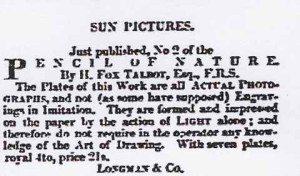
One of the bug that The Pencil of Natureand its successor, Sun Pictures in Scotland (1845) was the lack compatible quality of the prints (positives) and their continuous fading, even after publication, a sad inevitability that cheered painters who did not want contest from a mechanical camera.The Pencil of Nature was published in six installments between 1844 and 1846 (January, May, June, December, 1845 and Apr 1846) and due to lack of public response, time to come editions never materialized. That said, the book, with its twenty four plates, is designated asthe "first mass-produced photographically illustrated book," which is truthful, but that is a rather flat phrase for what was a very beautiful printed beautifully printed object in which the volume itself becomes an art form.Each plate is accompanied by a cursory description of the weather condition under which the image was taken. Whereas it is clear in examining the photographs in the book that the arrangements are done with creative intent and that the angles or framings were also selected with creative intent in regards to composition, Talbot notwithstanding understood his efforts to be a course of bear witness of a scientific process. It should be understood, that at this early stage, photography, its intents, its effects, its purposes, and its future was then completely unknown to this inventor. Like all the experimenters with light, Talbot had trivial idea of what he had started. In the article, "'Displaced Origins:' William Henry Pull a fast one on Talbot'south The Pencil of Nature" (2008),Vered Maimon wrote that
Talbot'southward conception of the document, then, is a photographic distillation of the evidentiary structure of positivism, of the circular, naturalizing, cocky-ostending model of evidence shared past the mod discourses of science, history and law.' The status of the photograph as a document therefore hinges on its ontology as a straight trace of nature–an index, yet it is besides modeled on the evidentiary structure of positivism which was extended in the mod period to other forms of knowledge.. For Talbot in The Pen cil of Nat ure , the status of the photograph every bit a document and testimony oscillates betwixt its capacity to copy, to accurately depict everything the camera sees (similar a 'legal' or archival document), and its capacity to evoke the imagination past introducing unexpected 'petty' details and therefore variety into what is often described by Talbot as a sixsually homogeneounited states of america surfaceastward.
Although numerous authors accept attributed "Romantic" or "antiquarian" ambitions to Talbot's photographic works, it is easier to understand his photographic books as office of his entire career, during which he had published a number of books, all with the intention of providing data about his invention. That said, when his photographs are examined, information technology is clear that we are viewing the mind and the eye of a human being of great intelligence and curiosity and a late blooming latent talent for art that was finally expressed in photographs. The Open Door is carefully framed around the open door with the artfully angled broom blocking the entrance captured at the very minutes of an angled shadow which, similar the broom provides diagonals in dissimilarity to the verticals of the archway.
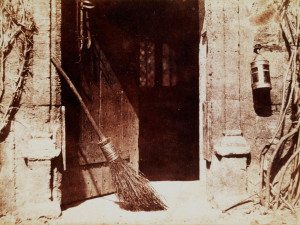
The Open Door, Plate 6
The row of leather-bound books carefully bundled on open shelves are both upright and tilted to interrupt the monotony of the paced rows. The leaning is casual, as would be the case in a well-read library, and the occasional white patches for titles dance on the occasional spines, punctuating as if they were musical notes on a ruled page.
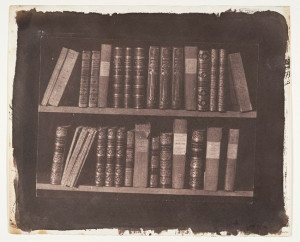
A Scene in a Library, Plate VIII
Nelson's Column, photographed during construction, was interesting to Talbot, not in its ascent height, but in its base where the structure used past the builders provide a lattice of blueprint, which is the focus of the study. The old church of St. Martin's of the Fields and its competing spire reides in the background as if watching over the awaiting secular and military erection that would take ten years to complete.
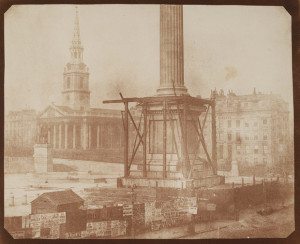
Nelson's Cavalcade, Nether Construction (1844)
In addition, a simple comparison with his first attempts at photographing his habitation, Lacock Abbey, and his after images, makes information technology articulate how rapidly Talbot could progress if he put his listen to working as a photographer.
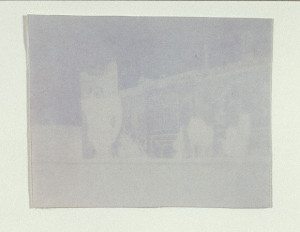
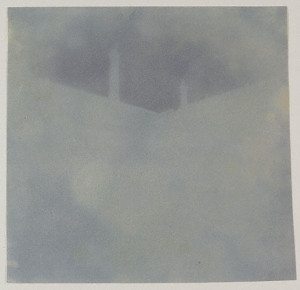
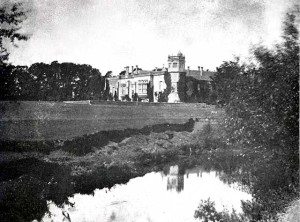
Lacock Abbey in Wiltshire, Plate XV
Talbot's valet and photographic assistant, Nicolaas Henneman (1813-1898), carried on Talbot'south work, with some financial support from his employer, in the commercial areas. Henneman, who seems to have no particular talents in the art of photography, nevertheless attempted to establish himself independently in Reading in what was the first institution dedicated to printing photographs. When the difficulty of selling the very books that were printed there—the editions of The Pencil of Nature—this thought of photographic books proved untenable, he relocated to London in a Talbot financed venture, "Nicolaas Henneman's Sun Moving-picture show Rooms." But the Sun Pictures were still another in what would be a serial of failed attempts to establish Calotypes in the field of photography that was moving fast and growing quite quickly. It seems that Talbot'due south health began to neglect in the 1850s, but, for whatever reason, by 1851 he turned to deciphering cuneiform inscriptions of Nineveh. And that is the terminal we hear of Talbot and his remarkable Calotypes.
If you have found this fabric useful, please give credit to
Dr. Jeanne S. M. Willette andArt History Unstuffed. Cheers.
[electronic mail protected]
Source: https://arthistoryunstuffed.com/william-henry-fox-talbot-1800-1877-part-two/
0 Response to "What Art and Style of Art Influenced Talbot in His Creation of the Open Door?"
Post a Comment